
The Future of Mobility
Autonomous driving, eVTOL aircraft and the hidden challenge of battery safety
The mobility revolution is not only a software challenge. It is also a materials-engineering challenge. Safe scaling depends on controlling the physical consequences of high-energy battery failures.
How will mobility look in the future? Will we continue to drive cars ourselves, or will autonomous vehicles eventually take over? The most realistic answer is not a sudden replacement of people, but a gradual transition in which human control and machine intelligence coexist.
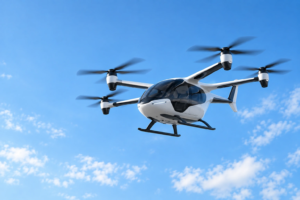
eVTOL
Automation is advancing quickly, yet today’s systems still struggle with the full variety of real-world situations. Construction zones, unusual road behavior, difficult weather, sensor contamination and rare edge cases demand contextual judgement that remains difficult to reproduce reliably and at scale. For that reason, broad deployment depends on more than better algorithms. It requires robust hardware, validated safety concepts, regulation, infrastructure and public trust.
At the same time, a second mobility layer is emerging: Advanced Air Mobility. Electric vertical take-off and landing aircraft, commonly known as eVTOLs, are intended to connect cities and regions with short, electrically powered flights. Eve Air Mobility, an Embraer company, has announced plans for dedicated production capacity, while BAE Systems has explored defense applications for Eve’s platform. These developments show how quickly electric aviation is moving from concept work toward industrialization and specialized use cases.
From Assisted Driving to Autonomous Mobility
The path toward autonomy is best understood as a spectrum. Driver-assistance systems can already support steering, braking and speed control under defined conditions. More advanced systems may handle entire trips within restricted operational areas. Full autonomy, however, requires a vehicle to manage ordinary traffic as well as unpredictable events without depending on a human fallback.
| Development stage | Primary capability | Key limitation |
|---|---|---|
| Driver assistance | Supports defined driving tasks | Human remains responsible |
| Conditional automation | Operates within a limited domain | Requires controlled conditions or fallback |
| Full autonomy | Handles the complete driving task | Not yet proven for unrestricted use at scale |
The central issue is safety. A mobility system must protect passengers as well as people around the vehicle. In aviation, the tolerance for failure is especially low. This is why the safety of the electrical energy-storage system becomes a decisive part of the overall vehicle architecture.
The Critical Bottleneck: High-Energy Battery Systems
Electric road vehicles and eVTOL aircraft depend on battery packs that combine many individual lithium-ion cells. An aviation pack may contain thousands of cells because each cell contributes only a fraction of the energy and power required for flight. This modular architecture offers performance and packaging advantages, but it also creates a propagation risk.
A single cell failure is already a serious event. The system-level danger increases when heat, flame, pressure and hot ejecta from that cell affect adjacent cells. If neighboring cells enter the same uncontrolled state, the failure can propagate through a module or pack and develop into a chain reaction.
Thermal Runaway: Understanding the Failure Mechanism
Thermal runaway is a self-accelerating failure process in which internal heat generation exceeds the cell’s ability to dissipate heat. The event can release hot gases, flame, particles and mechanical ejecta. According to the technical application information provided for this article, localized ejecta temperatures may reach approximately 1,600 to 2,000 °C in severe cell-failure scenarios.
The engineering objective is therefore not simply to make a cell impossible to fail. No complex system can rely on that assumption. Instead, the design must detect, isolate and contain a failure so that one event does not become a pack-wide emergency.
Engineering the Solution: Thermal-Runaway Protection
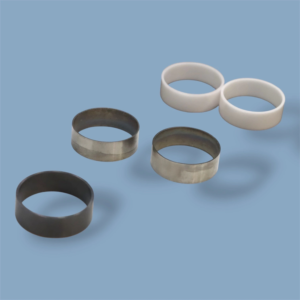
The rings help prevent fire and heat from spreading to neighboring battery cells.
Effective protection begins at cell and module level. Depending on the battery architecture, engineers can combine spacing, cooling, vent paths, barriers, shields, rings, tubes and structural enclosures. The protective concept must manage several loads at once:
- extreme short-duration temperature exposure
- high-velocity particles and molten or incandescent ejecta
- pressure pulses and mechanical impact
- rapid thermal gradients and repeated manufacturing tolerances
- electrical insulation and controlled venting requirements
Material selection is only one part of the solution, but it is a critical one. Conventional metals may lose strength, soften, melt or erode when directly exposed to extreme ejecta. High-temperature material classes such as tungsten-based materials, tungsten carbide and technical ceramics can offer an attractive combination of temperature resistance, hardness and erosion resistance.
Why Tungsten Carbide and Technical Ceramics?
| Material class | Potential strength | Engineering consideration |
|---|---|---|
| Tungsten carbide | Very high hardness; strong resistance to erosive ejecta; high-temperature capability | Brittleness, joining method, geometry and handling must be considered |
| Technical ceramics | High-temperature stability; electrical insulation; low density possible depending on grade | Thermal-shock behavior and fracture toughness vary strongly by ceramic system |
| Refractory metals / alloys | High melting range and useful toughness in selected designs | Mass, oxidation, forming and cost may influence suitability |
No material should be selected from a data sheet alone. Final performance depends on grade, thickness, geometry, support conditions, interfaces and the complete failure scenario. Component-level and pack-level testing remain essential. A hard material may resist ejecta extremely well, for example, while still requiring careful mechanical support to avoid damage during assembly and service.
Advanced Materials as an Enabler of Future Mobility
The future of mobility will likely be hybrid: people and machines will share responsibility, automation will expand step by step, and new transport modes will complement road and rail. Whether the application is an autonomous road vehicle, an air taxi or a specialized defense platform, adoption will move at the speed of safety.
Safety will determine the speed of adoption, and advanced materials will help determine the level of safety.
For battery protection, the decisive task is to prevent a local failure from becoming a system-wide event. This requires an integrated design that combines cell chemistry, monitoring, cooling, venting, structural containment and high-temperature protection. Tungsten carbide and technical ceramics can contribute where extreme local temperature, erosion and ejecta resistance are required.
Graf Hartmetall supports customers in evaluating hardmetals, tungsten-based solutions and technical ceramics for demanding applications. The objective is not simply to specify the material with the highest headline temperature. It is to identify a manufacturable component concept that performs reliably within the complete system.
Conclusion
We are moving toward more automated, electric and connected mobility, but a complete replacement of human capability is not imminent. The transition will be gradual and will depend on proven safety in daily operation. Battery systems are one of the most important engineering challenges in that transition, particularly where thousands of cells are combined in compact, high-power packs.
Once the propagation problem is understood, engineers can design targeted countermeasures. High-temperature protection made from tungsten carbide, technical ceramics or other refractory materials may become a key building block in safer battery architectures. The future of mobility will be shaped by software, but it will be made possible by materials that continue to perform when conditions become extreme.
Editorial note
This article is intended as a technical overview. Battery safety concepts and material choices must be validated for the specific cell, pack architecture, operating conditions and applicable certification requirements.


